


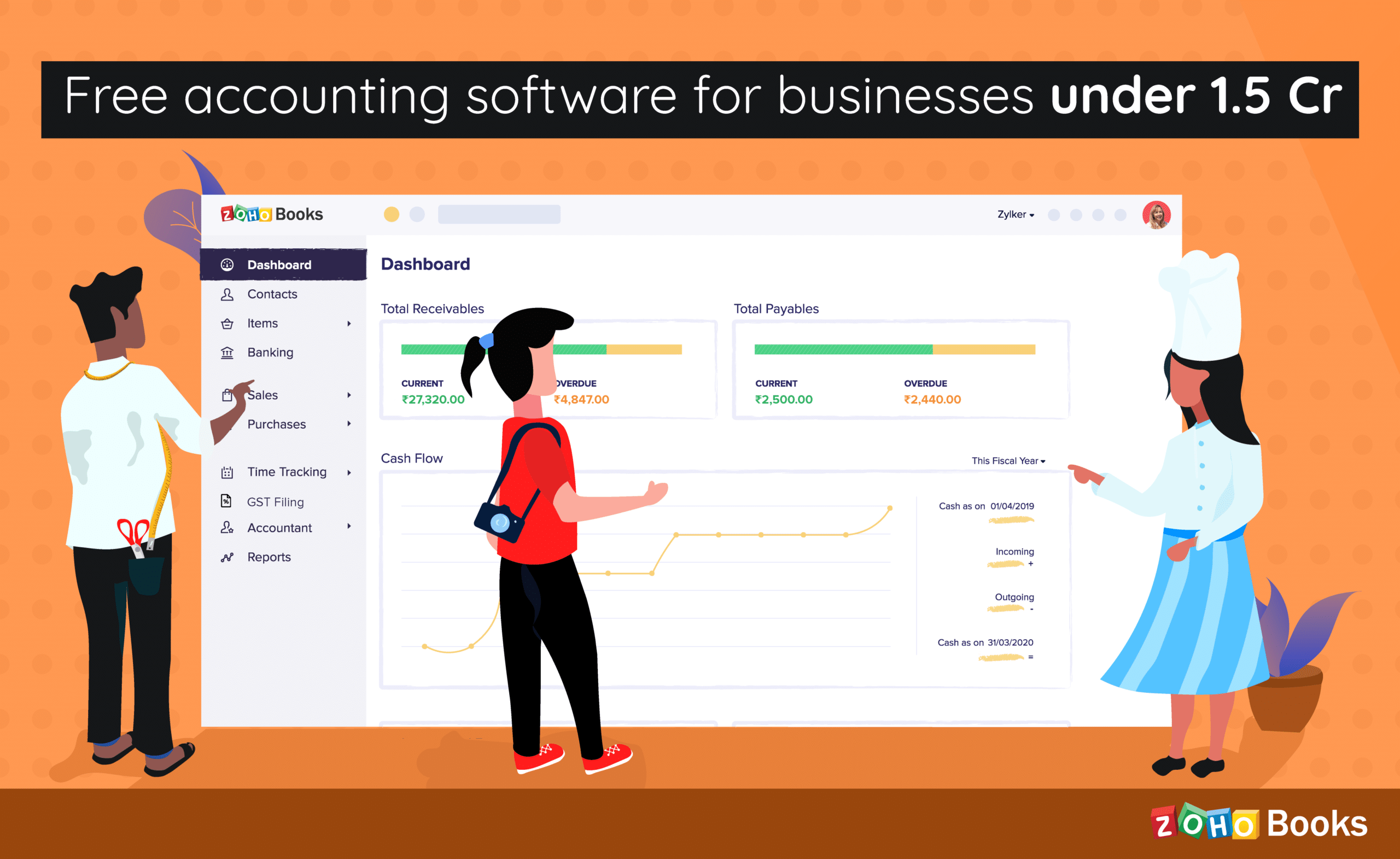
In a groundbreaking move, the Goods and Services Tax Network (GSTN) has joined forces with leading software vendors to offer a suite of free accounting and billing software solutions. This collaboration aims to empower businesses across India with accessible tools for financial management. Let’s delve into the details and explore the software offerings provided by these esteemed partners.
 1. Zoho Corporation Private Limited – ZOHO Books:
- Sale, purchase, and cash ledger management
- Streamlined inventory management
- Comprehensive supplier and customer master data
- Effortless invoice creation and account statement generation
- Hassle-free GST returns preparation
 2. Marg ERP Limited – MARG GST Pro:
- Efficient accounting and billing processes
- Instant invoice generation
- Automatic inventory updates
- Seamless account statement creation
- Easy GST returns filing
 3. Relyon Softech Limited – SARAL ACCOUNTS:
- Simplified sale, purchase, and cash ledger management
- Precise inventory management
- Comprehensive supplier and customer master data
- Convenient invoice creation and account statement preparation
- Seamless GST returns filing
 4. Seshaasai Business Forms Private Limited – GENIEBOOKS:

- Streamline sale, purchase, and cash ledger management
- Optimize inventory management
- Manage supplier and customer master data effectively
- Create invoices and account statements effortlessly
- Facilitate GST returns preparation
 5. Focus Softnet Private Limited – FOCUS LYTE:

- Streamlined sale, purchase, and cash ledger management
- Inventory management for enhanced control
- Supplier and customer master data management
- Quick invoice generation and account statement creation
- Hassle-free GST returns filing
 6. Adequate Info Private Limited – UBOOKS:

- Efficient sale, purchase, and cash ledger management
- Inventory management for better control
- Comprehensive supplier and customer master data
- Easy invoice creation and account statement generation
- Simplified GST returns preparation
 7. Cygnet Infotech Private Limited – Cygnet FACE:

- Manage sale, purchase, and cash ledgers with ease
- Optimize inventory management
- Maintain supplier and customer master data efficiently
- Generate invoices and account statements effortlessly
- Facilitate seamless GST returns filing
 8. IRIS Business Services Limited – IRIS Vyapari:

- Streamlined sale, purchase, and cash ledger management
- Robust inventory management capabilities
- Supplier and customer master data management
- Effortless invoice creation and account statement generation
- Convenient GST returns preparation
These software offerings are readily available for download on the official GST Portal³, accessible at www.gst.gov.in. To acquire these accounting and billing solutions, taxpayers must log in to the GST Portal with valid credentials.
Why Free GSTN Accounting Software Fails Scale: The Architectural Limitations of Basic Cloud Ledgers for Real-Time Retail
The Goods and Services Tax Network (GSTN) partnership offering “free” billing and accounting software to small businesses sounds like an ideal cost-cutter on paper. However, for active retail environments, high-volume distributors, and scaling enterprises, these free tiers introduce structural vulnerabilities that can stall daily operations.
These applications are engineered for basic, post-facto compliance compliance tracking—not for the rigorous demands of real-time, high-concurrency point-of-sale environments.
Before migrating your enterprise ledgers to a free government-partnered cloud ledger, you must evaluate the four critical architectural limitations that cause these systems to fail at scale.
1. The Cloud-First Latency Trap
Most free GSTN-partnered applications are lightweight web interfaces or basic mobile wrappers dependent entirely on continuous remote server handshakes.
The Retail Reality: A checkout counter requires sub-second transaction times. If your software requires a full round-trip WAN (Wide Area Network) request to validate every single barcode scan against a cloud database, your billing speed collapses during peak hours.
The Failure State: When regional internet routing slows down, or the software provider’s shared cloud servers experience high concurrent loads, your checkout line grinds to a halt. Free tiers rarely guarantee dedicated server resources or strict Service Level Agreements (SLAs).
2. Artificial Scaling Caps (The Premium Upsell Bait)
“Free” in the software ecosystem is rarely philanthropic; it is a customer acquisition funnel.
Hidden Thresholds: Many free tiers silently cap your operational scaling. You may face strict hidden limits on the maximum number of inventory items (SKUs) you can store, the number of invoices you can generate per month, or the number of active terminal counters you can connect.
The Transition Trap: The moment your retail store scales from a small shop to a high-volume supermarket or multi-warehouse distributor, you hit a paywall. You are then forced into expensive, recurring subscription models to unlock basic features like multi-user access, weighted-scale barcode parsing, or advanced expense trackers.
3. Absence of Strict Offline & LAN Resiliency
A reliable industrial system must assume that infrastructure will fail. Free cloud ledgers operate on the naive assumption of 100% internet uptime.
Zero Fault Tolerance: If your broadband line or local Wi-Fi drops, these platforms lock up completely. You lose the ability to check real-time stock levels, pull up customer outstanding balances, or generate valid tax invoices.
Isolation Vulnerability: Unlike dedicated local-master architectures that allow multiple billing counters to communicate seamlessly over a local ethernet switch during a WAN failure, free cloud apps isolate each terminal. If the outside network goes dark, your entire facility goes blind.
4. Obfuscated Database Schemas and Vendor Lock-In
Maintaining clean data sovereignty is critical for tax audits and internal financial analysis. Many free tools employ proprietary, closed database schemas that store your transactional history in opaque formats.
The Auditing Nightmare: Exporting years of clean ledger entries, flat-file sales logs, or granular stock histories into universal formats (like structured CSV or open SQL schemas) is often intentionally restricted or degraded on free tiers.
The Leverage Play: By making data extraction difficult, vendors create a state of synthetic lock-in. It becomes easier to pay their premium recurring subscription fees than to navigate the technical friction of migrating your own data out of their ecosystem.
Engineering for Real-World Reliability
Active business infrastructure requires structural autonomy. Your daily checkout volume, accounting speed, and data privacy should never be subject to the resource limitations of a shared, free tier cloud server.
WeBFooT SMART RETAIL was engineered specifically to solve these operational pain points. By utilizing a true offline-first transaction engine paired with an open, high-performance local database architecture, WeBFooT processes up to 1,000,000 SKUs instantly on low-spec client hardware—independent of active internet connections or restrictive scaling caps. You retain 100% ownership of your data, permanent lifetime licensing, and absolute operational uptime.