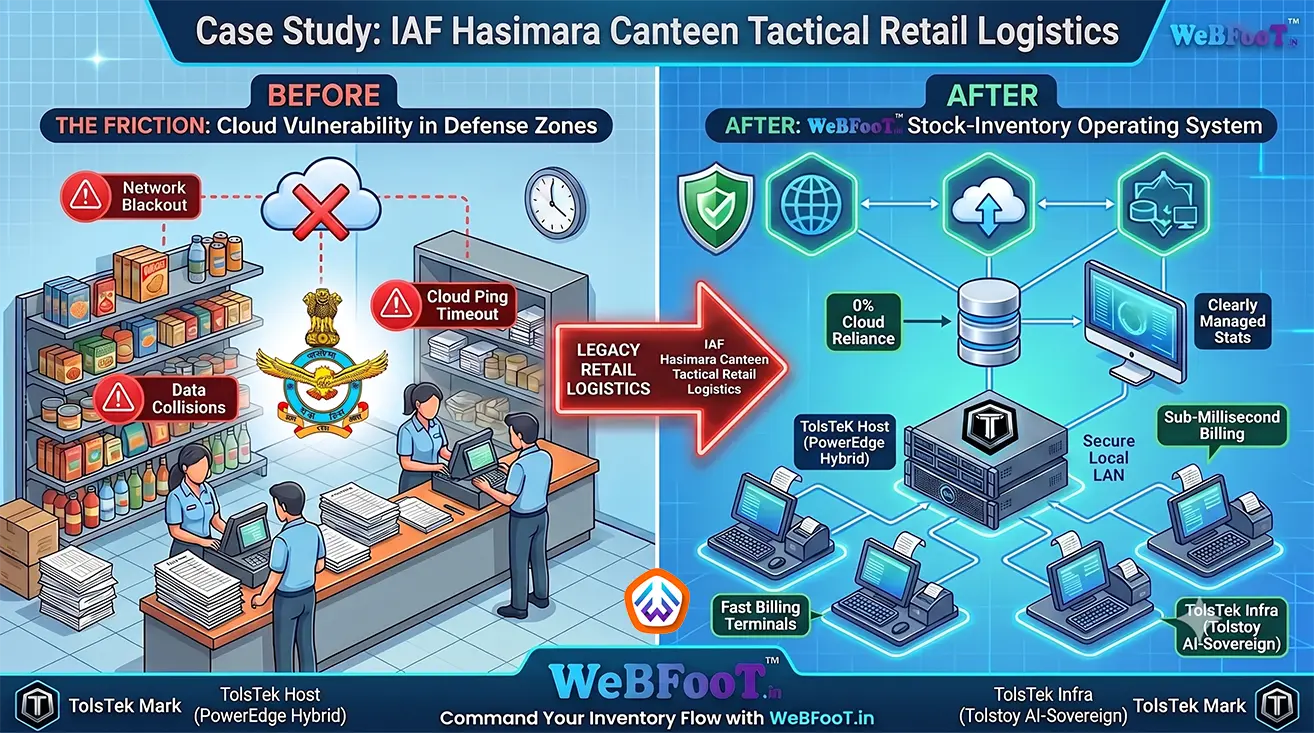

In the retail tech world, developers build cloud-first point-of-sale systems assuming every store has high-speed fiber internet and high-end hardware. However, real-world Indian retail does not operate in a perfect cloud environment.
Years ago, a client approached us with a unique operational challenge. They were opening Bamboo’s Kitchen, a restaurant located in a remote village in Kashmir.
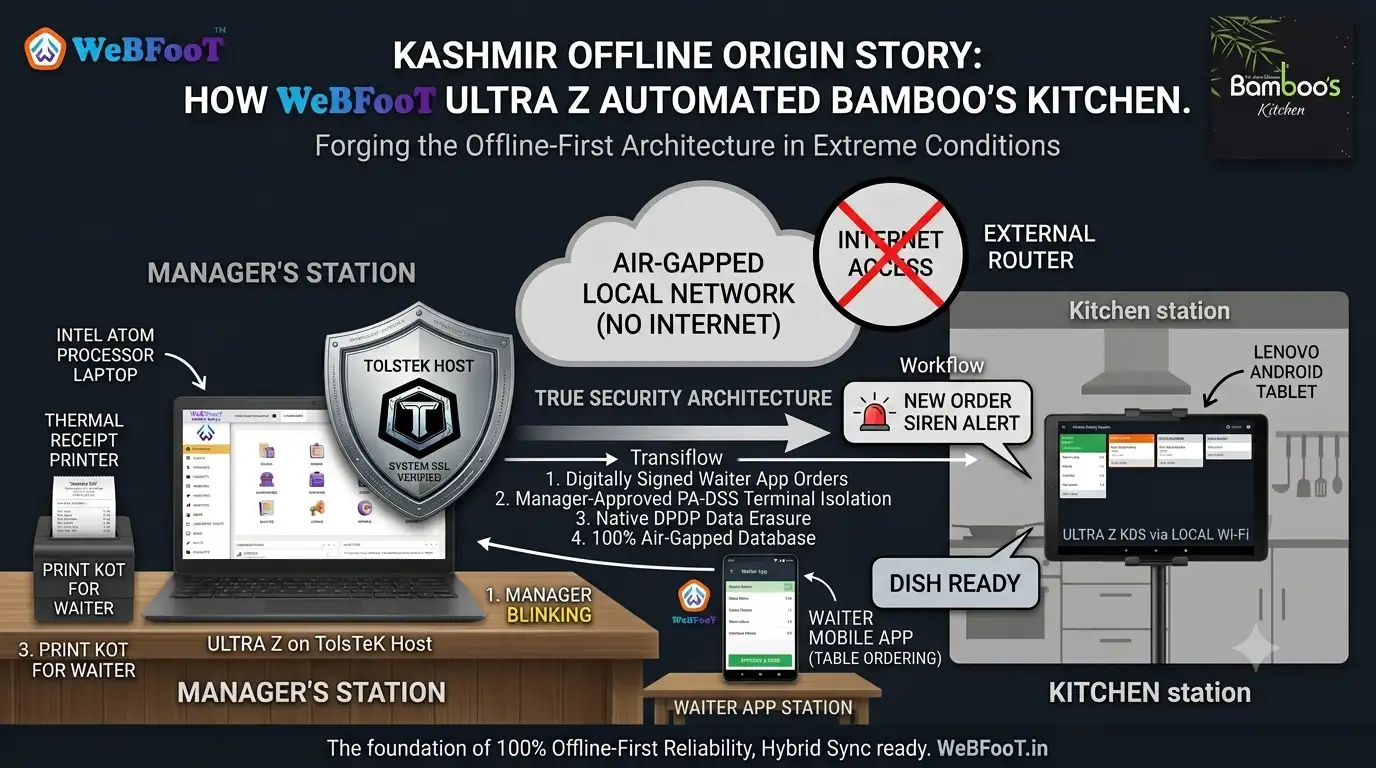
The site had zero internet access, no mobile cellular data, and no physical Wi-Fi router. The client only had an entry-level laptop powered by a low-spec Intel Atom processor, a local thermal receipt printer, an Android tablet for the kitchen, and mobile phones for the waiters.
They needed a real-time Kitchen Order Ticket (KOT) management system. Standard cloud POS software failed completely. Consequently, we built the very first iteration of WeBFooT Ultra Z POS.
1. Turning a Low-Power Laptop into an Offline Server
To solve the network bottleneck, we engineered the software to run completely self-contained on the store’s physical hardware.
We installed Ultra Z running inside the TolsTeK Host environment directly on the Intel Atom laptop. Next, we configured the laptop’s internal Wi-Fi adapter to act as a local Wi-Fi Access Point (Hotspot).
Without an external router or an active internet connection, the system created an isolated, air-gapped local area network. In the dining area and kitchen, devices connected directly to this local hotspot:
Waiters’ Mobiles: Handheld phones connected to the local Wi-Fi to take orders at the table.
Kitchen Tablet: A Lenovo tablet mounted in the kitchen accessed the Kitchen Display System (KDS) by pointing its browser to the laptop’s local IP address.
2. The Bamboo’s Kitchen Real-Time KOT Workflow
Despite operating on low-power hardware without internet, Ultra Z delivered instantaneous, multi-device kitchen automation through local socket connections:
Table Order via Mobile App: The waiter took orders directly at the table using the mobile app over local Wi-Fi. The order routed instantly to the manager’s laptop for approval.
Manager Approval & Kitchen Dispatch: Once approved by the manager (or automatically routed), the system dispatched the order to the kitchen.
Instant Kitchen Alert: The moment the order reached the kitchen, the Lenovo tablet triggered an audible siren alert, notifying the chef of a new incoming ticket.
Chef Readiness Signal: Once the chef prepared the dish, they tapped the “Ready” button on the tablet screen.
Manager Visual Notification: Tapping the button immediately made the manager’s laptop screen flash visually, signaling that the food was ready for pickup.
KOT Printing & Service: The manager printed the physical KOT ticket on the thermal printer and handed it to the waiter. The waiter presented the KOT to the kitchen, retrieved the hot food, and served the guest.
Live Table Timer: While the guest dined, a live timer ran on the manager’s dashboard, showing exactly how long the table had been occupied.
Checkout & Completion: When the guest finished eating, the manager generated the final bill, processed the payment, and completed the order.
3. The Evolution: Hybrid Offline-First Cloud Sync
The extreme constraints of Bamboo’s Kitchen proved that software must execute locally to guarantee 100% uptime. Therefore, we made offline-first execution the foundational core of the entire WeBFooT Ultra Z architecture.
Today, Ultra Z brings this exact same air-gapped reliability to modern cloud-connected businesses:
Uninterrupted Local Execution: Whether deployed on a local machine or connected to a cloud server, Ultra Z processes every transaction, billing event, and KOT local-first. If internet cables get cut or cloud servers crash, your checkout counters never stop.
Automatic Background Synchronization: When internet connectivity returns, Ultra Z seamlessly syncs local sales records, inventory movements, and ledger updates back to the cloud database in the background with zero operator intervention.
Zero Latency at Peak Hours: By removing live network requests from the active billing loop, cashiers never experience loading spinners or network timeouts during busy sales hours.
Engineered for Extreme Realities
We did not design WeBFooT Ultra Z POS inside a corporate boardroom with high-speed internet. We forged it in a remote Kashmiri village on a low-power Intel Atom processor.
By prioritizing local database execution, local socket networking, and seamless background cloud sync, Ultra Z guarantees that your business stays operational no matter what happens to your network.