
Why Cloud ERPs Cost High-Volume Retailers 30% in Lost Peak-Hour Sales
For the modern, high-volume retailer, the true cost of software isn’t measured in monthly subscription fees—it is measured in transactional latency.
Cloud-only ERP and POS systems have successfully marketed the convenience of remote server hosting. However, they silently ignore the brutal mathematics of real-time retail environments. When your store experiences a peak-hour rush—such as weekend festival crowds or evening supermarket queues—relying on a remote cloud database server becomes an active operational liability.
The Brutal Reality: If your billing speed drops by just a few seconds per customer, your checkout lines lengthen exponentially, causing frustrated shoppers to abandon their carts.
Here is the technical breakdown of why pure cloud architectures cause significant revenue leaks during critical sales windows, and how true offline-first engineering protects your bottom line.
The Latency Math: How Seconds Turn into Lost Revenue
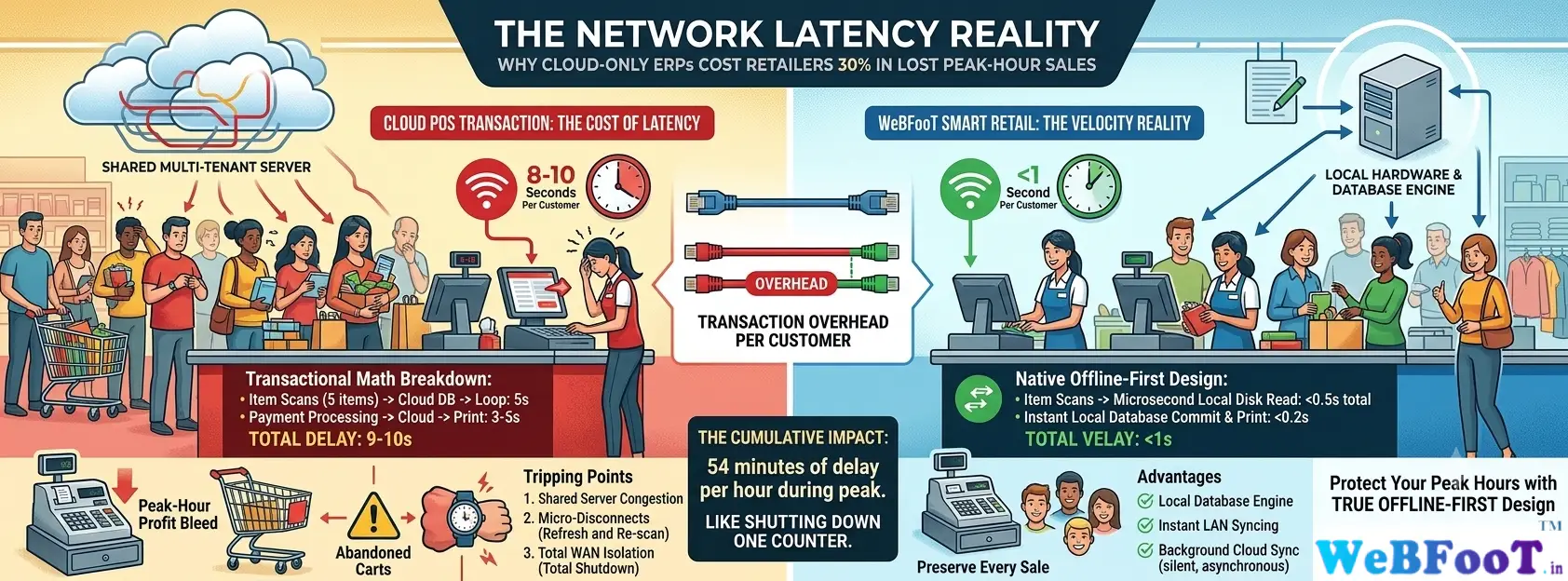
In a high-volume retail outlet, billing velocity dictates profitability. Let’s break down the mathematical reality of a cloud-dependent POS system versus a native local architecture during a standard transaction involving 5 scanned items.
Transaction Architecture Comparison
| Transaction Step | Cloud-Only POS Loop | WeBFooT Local Loop |
| Item Scans (1 to 5) | 5.0 seconds (Requires repeated loops: Router → ISP → Cloud Query → Server Process → Return) | <0.5 seconds total (Direct microsecond local disk read via native database indexing) |
| Payment & Tax Validation | 3.0 – 5.0 seconds (Full payload sync, GST slab validation, remote DB commit, print command) | <0.2 seconds (Instant local database commit and immediate printer spooling) |
| Total Billing Overhead | 8.0 – 10.0 seconds (Under ideal internet conditions) | Under 1.0 second (Complete local execution) |
The Cumulative Impact
During peak hours, if you process 200 customers per hour across 3 counters, that 9-second cloud latency overhead creates 54 minutes of pure, cumulative delay per hour.
(9 seconds delay/customer) × (200 customers/counter) × (3 counters) = 54 minutes of lost operational time per hour
That is equivalent to shutting down your billing counters entirely for nearly an hour during your most profitable period of the day.
The Three Structural Tripping Points of Cloud Infrastructure
1. The Shared Server Concurrency Bottleneck
Cloud SaaS platforms host thousands of retail stores on shared, multi-tenant cloud servers. During national festival seasons or major shopping holidays, every single store on that network hits the database simultaneously. The server’s CPU queues spike, database locking issues occur, and your checkout speed crawls—even if your local store’s fiber broadband connection is working perfectly.
2. The Micro-Disconnect Outage
Many business owners believe they are safe because they have high-speed broadband. However, standard internet connections experience dozens of unnoticeable “micro-disconnects” every day—brief packet drops lasting anywhere from 2 to 30 seconds.
While a standard web browser hides this via client-side caching, a cloud POS locks up instantly. The cashier is forced to refresh the application, re-authenticate their login session, and manually scan the entire customer cart all over again.
3. Total WAN Isolation Vulnerability
When a construction crew cuts a local telecom line or a severe monsoon takes down a local cellular tower, your cloud system goes completely dead. You cannot pull up credit customer balances, you cannot look up wholesale pricing structures, and you cannot issue a tax-compliant bill. Your entire business shuts down until a third-party utility company fixes the line.
Eliminating the Network Bottleneck
WeBFooT SMART RETAIL eliminates this architectural vulnerability by shifting the database engine entirely onto your local hardware. By running transactional operations locally, network latency drops to absolute zero.
- Instant Local Syncing: Multi-counter syncing occurs instantly inside the facility across your local LAN switch without sending data out to the wider internet.
- Asynchronous Cloud Backups: Remote cloud synchronization is treated as a silent, background task that queues data packets asynchronously, executing handshakes only when the network path is entirely clear.
Your billing infrastructure should be controlled by your cashiers, not your internet service provider. Protect your peak hours by choosing true, native offline-first design.