
The Client Profile
The Electrical Maintenance Department at the National Institute of Technology Calicut (NITC) is responsible for keeping a sprawling, high-density academic campus completely powered and functional. Their team manages thousands of high-turnover electrical assets—including tubelights, LED bulbs, ceiling fans, and switches—across dozens of hostels, administrative blocks, laboratories, and lecture halls.
🛑 The Friction: The Campus Maintenance Black Hole
With hundreds of maintenance requests pouring in daily, the department’s legacy pen-and-paper or disjointed digital workflows created severe operational bottlenecks:
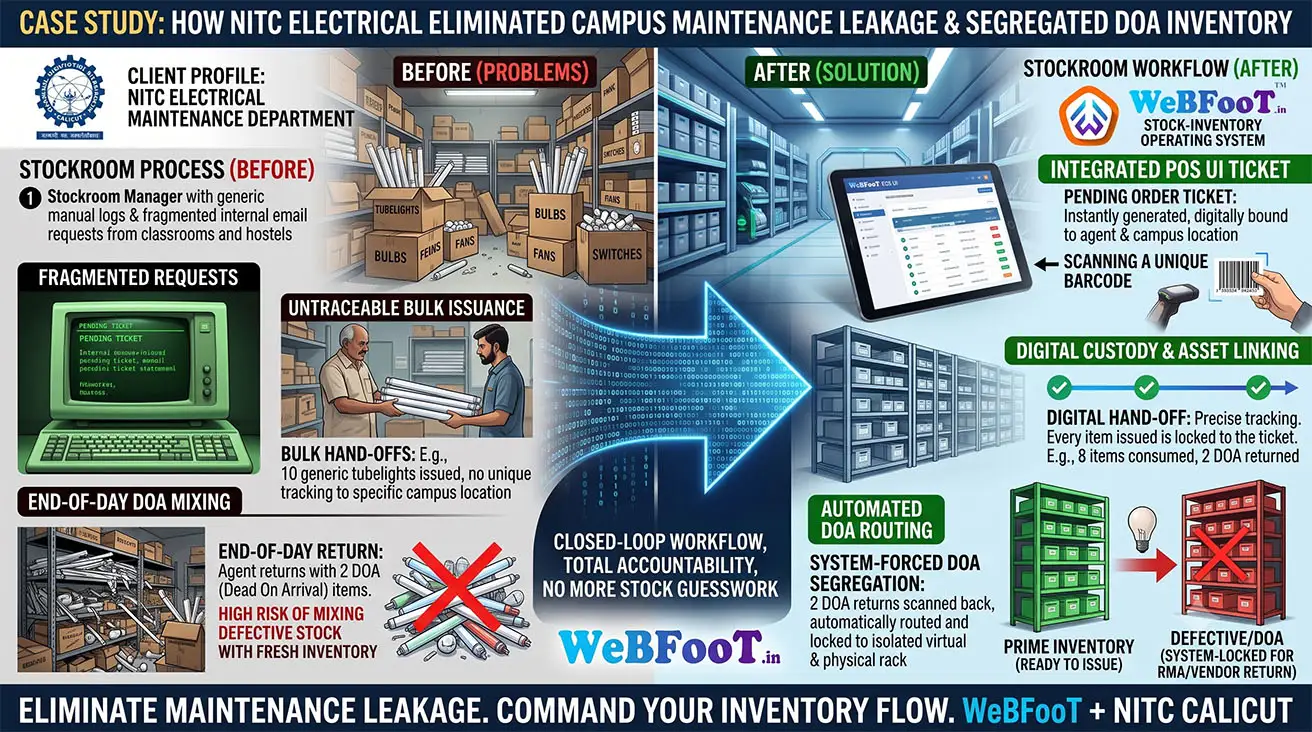
- The Lost-in-Transit Hand-off: When field agents received localized email alerts (e.g., “Hostel C, Room 302: 3 dead tubelights”), they had to physically walk to the central stock room. The stock room manager had to manually log and process the items, leading to long queues and massive delays in updating stock balances.
- The Ticket-to-Asset Disconnect: Agents would request a bulk batch of items (e.g., 10 tubelights) to cover multiple campus spots. Because there was no immediate digital lock binding those items to a specific pending ticket, it was impossible to verify if all 10 items were actually installed or where the leftovers went.
- The Return & DOA Nightmare: At the end of a shift, agents frequently returned to the stock room with unused or Dead On Arrival (DOA) components. Without strict system partition rules, returned defective items were often mixed back into the prime inventory racks, leading to technicians accidentally re-issuing dead bulbs to the field.
The department desperately needed a robust, fool-proof POS and inventory workflow that closed the loop on field hand-offs, strictly isolated defective returns, and maintained absolute stock accuracy.
🛠️ The Solution: WeBFooT Ultra Z & Dual-State Inventory Routing
To permanently secure the maintenance pipeline, NITC deployed a localized campus instance of the WeBFooT Stock-Inventory Operating System featuring a specialized field-agent POS interface.
The system streamlined the entire maintenance cycle into four bulletproof steps:
1. Ultra Z Ticket Creation
When a field agent arrives at the stock room with an email request, the stock room manager uses the high-velocity WeBFooT Ultra Z to instantly generate a Pending Order Ticket. This ticket is digitally bound to the requesting department, specific room location, and the assigned agent.
2. Digital Custody & Asset Issuance
The manager scans and issues the precise quantity of materials required (e.g., 10 tubelights). Rather than immediately deducting these as “consumed,” WeBFooT places these items in a temporary “Field Custody” status under that specific agent’s profile.
3. Isolated Return and DOA Routing
At the end of the day, the agent returns to the stock room to close the ticket. If 8 tubelights were installed and 2 were DOA:
- The 8 installed units are officially marked as Consumed and written off the active balance.
- The 2 DOA units are scanned back into the system. WeBFooT’s routing logic strictly bars these items from entering the main inventory pool. Instead, the system registers them under a dedicated “Defective/RMA” virtual location, prompting the manager to physically place them on Rack B (Defective Stock) for vendor replacement.
4. Zero-Lag Local Edge Performance
Because the stock room operates in a high-traffic environment with potential campus network fluctuations, WeBFooT runs on a Local Edge Cache. Transaction speeds remain sub-millisecond, ensuring that shift transitions and agent returns never experience database hang-ups.
📊 Performance Transformation Matrix
| Operational Metric | Legacy Workflow | WeBFooT OS Architecture |
| Ticket-Asset Binding | Zero link between the issue slip and the physical campus location. | Every item issued is locked to a specific pending ticket and location. |
| Field Stock Accountability | “Loose hand-off” of bulk items with no tracking of end-of-day balances. | Precise tracking of item status: Issued ➔ Installed or Issued ➔ Returned. |
| DOA/Defective Management | High risk of mixing defective stock with fresh inventory on the same racks. | Forced segregation logic: Defective returns are system-locked to isolated virtual and physical racks. |
| Data Processing Velocity | Manual data entry and laggy server lookups causing agent queues. | Instantaneous scans utilizing localized edge database synchronization. |
The Bottom Line
By implementing WeBFooT’s structured POS-to-Inventory loop, NITC’s Electrical Department converted a chaotic, high-turnover stockroom into a completely transparent, self-auditing node. They eliminated stock shrinkage, guaranteed that defective items never rejoin the active supply chain, and cut maintenance resolution times in half.
Stop Losing Track of Your Spares. Command Your Inventory Flow with WeBFooT.